The "State of DevOps 2026" report just dropped, and the data confirms a harsh reality: traditional automation has officially hit the ceiling. For years, we've relied on deterministic scripts to guard our releases, but as software architecture grows more complex, those scripts are breaking faster than engineers can fix them.
We created this guide to show you how Agentic DevOps is moving beyond simple "if-to then" automation into autonomous, goal-oriented systems. You'll understand how to implement Agentic DevOps solutions that don't just execute commands, they think, learn, and slash your time-to-market.
Understanding Agentic DevOPS Solutions – A Quick insight
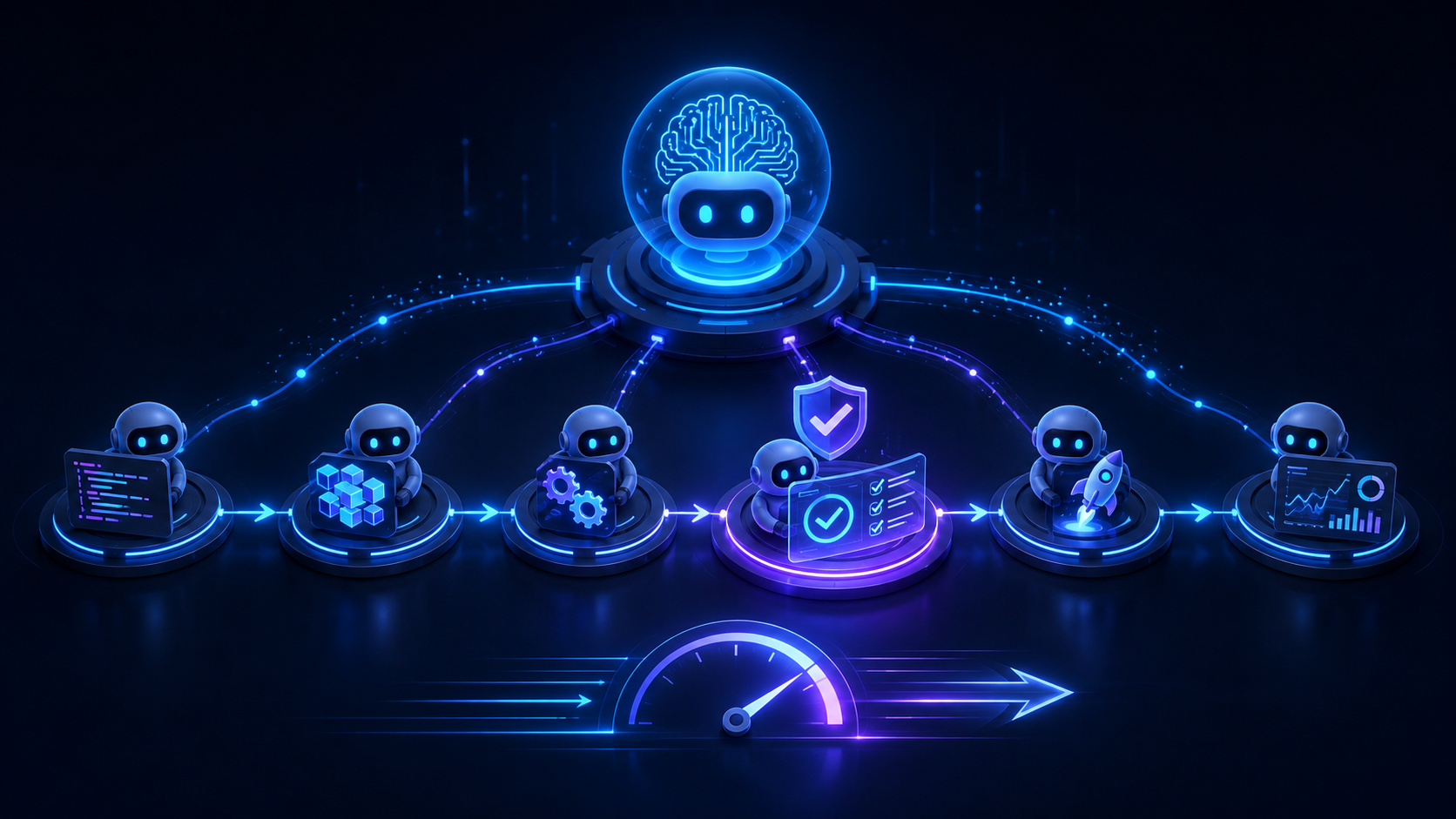
Agentic DevOps is a new paradigm that incorporates autonomous AI agents directly into CI/CD pipelines for software management, testing, and deployment. Some deployments have reported a 60% decrease in QA triage time.
Unlike controversial automation, these AI agents are capable of analysis, reasoning, and decision-making to self-heal pipelines and prioritize faults without continual human supervision.
Key Components of the Agentic DevOps Pipeline
Autonomous, proactive agentic workflows are used in place of manual, reactive testing to reduce QA time:
Self-Healing & Failure Analysis Agents
By combining these, organizations have reduced flaky test noise by ~60% and slashed manual triage time from 8 hours per week to under.
Multi-Agent Coordination
Specialized agents (e.g., Discovery agents for coverage, Generator agents for test creation, Analyzer agents for diagnosis) work in tandem to optimize the entire pipeline, rather than relying on a single, general AI tool.
Predictive Test Selection
AI analyzes code changes and runs only the most relevant tests, avoiding the need to execute the entire suite for every minor change.
Intelligent CI/CD Generation
Agents can generate full gitlab-ci.yml, Dockerfiles, and Terraform configurations simply by understanding natural language requests regarding the codebase.
Proven Results in QA & Development
Organizations leveraging agentic AI for testing and DevOps are realizing substantial efficiency gains in terms of:
- ✓60% Reduction in QA Time - Specific to designing and executing test cases, as seen in cases like JM Family Enterprises.
- ✓78% Reduction in Testing Duration - Autonomous testing pipelines can drastically lower test-to-deployment times.
- ✓60% Improvement in MTTR - Mean Time to Recovery is significantly lowered because AI agents proactively identify issues in production.
- ✓69% Reduction in Build Time - Through AI-powered auto-scaling and optimized pipeline steps.
Why Agentic DevOps Succeeds?
Traditional QA often creates bottlenecks in modern, fast-paced CI/CD pipelines. Agentic QA flips this by enabling:
Context-Aware Analysis
Agents minimize false positives by comprehending the context of a code modification.
Autonomous Decision-Making
Agents prioritize a failure, identify whether it is a bug or a flaky test, and recommend a fix rather than just reporting a failure.
Continuous Testing
Instead of being a manual obstacle at the conclusion of development, testing becomes an automated, ongoing activity.
Also Read: "The CTO's Guide to Agentic AI: Avoiding the Security Risks of Automation"
The Maintenance Myth That's Stalling Your Growth
Before we dive into the mechanics, let's dismantle a myth that has misled tech leads for a decade:
The idea that 100% test coverage through traditional automation equals speed. NOT AT ALL!
In reality, high-volume, "dumb" automation creates massive maintenance debt. When your UI changes by a single pixel, your legacy scripts break, forcing your senior engineers to spend their mornings babysitting code instead of innovating.
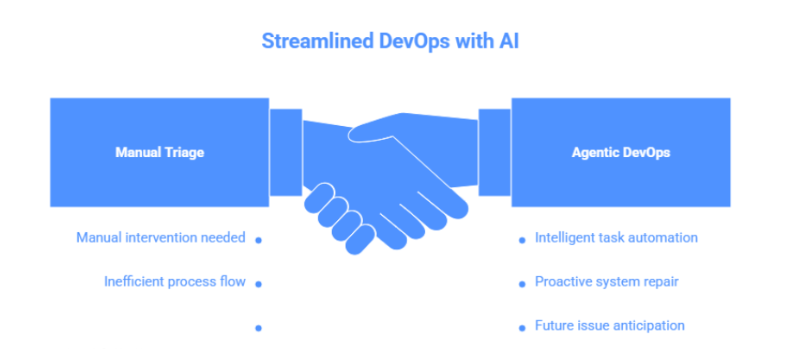
At Co-Ventech, we've learned that true speed comes from Agentic DevOps AI. Unlike rigid scripts, these agents understand context. If a button moves, the agent recognizes the change and adapts the test flow accordingly. We are seeing a shift where Agentic DevOps Microsoft frameworks and Agentic DevOps Azure integrations are becoming the major cornerstones of high-velocity teams, allowing them to focus on product excellence rather than script repair.
How We Helped Bluefin Reclaim 40 Hours a Week?
When the leadership at Bluefin approached Co-Ventech, they were drowning in:
"Friday at 4 PM" dread. Their legacy pipeline was a spiderweb of Jenkins jobs that took 72 hours to clear. One minor update to their fintech platform could trigger hundreds of false-positive failures.
Our team stepped in to deploy Agentic DevOps tools that act as autonomous gatekeepers. By leveraging Agentic DevOps with GitHub Copilot, we enabled the pipeline to write its own unit tests based on real-time code commits.
The Result?
Bluefin didn't just save time; but also transformed their culture. Our QA cycle dropped by 60%, allowing them to pivot from "reactive firefighting" to "proactive innovation." Their CEO noted that Co-Ventech's commitment to responsiveness made them a strategic partner, not just a service provider.
The Technical Engine: Agentic DevOps Reactors
The secret sauce behind these results lies in Agentic DevOps reactors. Think of these as the "brain cells" of your CI/CD pipeline. While traditional tools follow a linear path, a reactor is goal-oriented. When a developer pushes code, the reactor evaluates the impact.
It doesn't just run every test in the deck. It uses a mathematical approach to risk:
P(f|c) > τ
The system calculates the probability (P) of a failure (f) given the specific code changes (c). If the risk exceeds the threshold (τ), the agent executes the specific tests needed. This intelligent filtering is how we cut hours of redundant processing out of every single build.
Scaling Without the Friction
The biggest fear for agency owners is, that scaling a team means scaling the chaos. We've seen that Agentic DevOps acts as a force multiplier. We recently worked with a SaaS startup that needed to move from monthly releases to daily deployments.
By integrating Agentic DevOps solutions, Co-Ventech helped them automate their compliance and security checks. Instead of waiting for a manual audit, their Agentic DevOps AI performed real-time threat modeling during the build. They scaled their user base by 10x without adding a single QA hire.
Why Co-Ventech is the Choice for Modern Engineering?
Success in 2026 isn't about having the most developers; it's about having the smartest architecture. Co-Ventech positions itself at the intersection of human-centered AI and technical expertise. We do not just "fix" pipelines, rather architect future-proof systems that value:
Intrinsic Efficiency
Every second saved in QA is a second spent on market-dominating features.
Digital Product Design
Ensuring the end-user experience is never compromised by speed.
Modern Engineering Talent
Using Agentic DevOps tools to empower your engineers, not replace them.
Final Verdict: Lead or Follow?
The era of "set it and forget it" automation don't work anymore. You can either stay trapped in the cycle of broken scripts and delayed launches, or you can embrace a pipeline that thinks, adapts, and wins. Agentic DevOps is the only way to achieve true digital agility in a high-speed market.
If your team is spending more time fixing tests than shipping features, it's time for an upgrade. Co-Ventech specializes in building the high-performance pipelines that modern brands demand.
Ready to reclaim your engineering time? Book a DevOps Strategy Audit with Co-Ventech today and see exactly how we can cut your QA time by 60% or more. Let's build something faster, together.