It's 2:00 AM. A critical bug just bypassed your automated testing suite, a high-value lead is waiting for a personalized response that your out-of-office bot can't handle, and your DevOps pipeline is stalled because of a configuration mismatch. For most agency owners and tech leads, this is the LLM hangover: the realization that while ChatGPT is a brilliant conversationalist, it also works as a mediocre employee. You have integrated basic chatbots, yet your team is drowning in the manual glue work required to make those bots useful.
The industry is reaching a breaking point where simple prompt-and-response cycles are no longer enough to stay competitive. If you are still treating AI as a high-speed typewriter, you are missing the architectural shift that defines the next decade of software.
At Co-Ventech, we have seen the chatbot ceiling firsthand. You have likely integrated an LLM to answer customer queries or draft emails, but the results often feel like a glorified autocomplete. The real breakthrough is not in the model itself, but in the architecture surrounding it.
In this guide, we are pulling back the curtain on agentic workflows. We will explore the agentic workflow meaning, compare agentic workflows vs agentic agents, and provide a blueprint for building agentic workflows for modern software. By the end of this read, you will understand how to transition from static bots to autonomous systems that actually move the needle for your agency. Let's begin with understanding.
Agentic AI meaning
An agentic workflow is an autonomous, iterative AI process in which AI agents use tools and reasoning to solve issues on their own by breaking down large tasks into smaller parts. These systems, also known as autonomous agent workflows or AI agent orchestration, plan, act, reflect on outcomes, and make adjustments, in contrast to static, single-prompt AI. They are employed in data analysis, customer support, and automated research.
Key characteristics and usage examples
Autonomous planning and action: agents take a high-level objective and identify the required subtasks. Tool use: agents communicate with external systems such as databases, CRMs, and the web (for example sending emails) to retrieve information or carry out operations. Reflection and self-correction: without human input, the AI assesses its own output, loops back to fix errors, and improves performance.
Agentic workflow examples
Customer support: without human intervention, an agent reads a complicated query, retrieves order history from a SQL database, computes a refund, and updates the CRM.
Marketing campaign management: agents compile campaign materials, produce content, update marketing libraries, and produce AI summaries for approval.
Data analysis and research: an agent searches the web on its own, accumulates data from various sources, and creates a final report. These examples show how software engineering is entering a managerial era. Prominent platforms such as GitHub Next are already demonstrating how these workflows transform the developer experience, from code creation to AI bot management.
What it takes: building agentic workflows for modern software
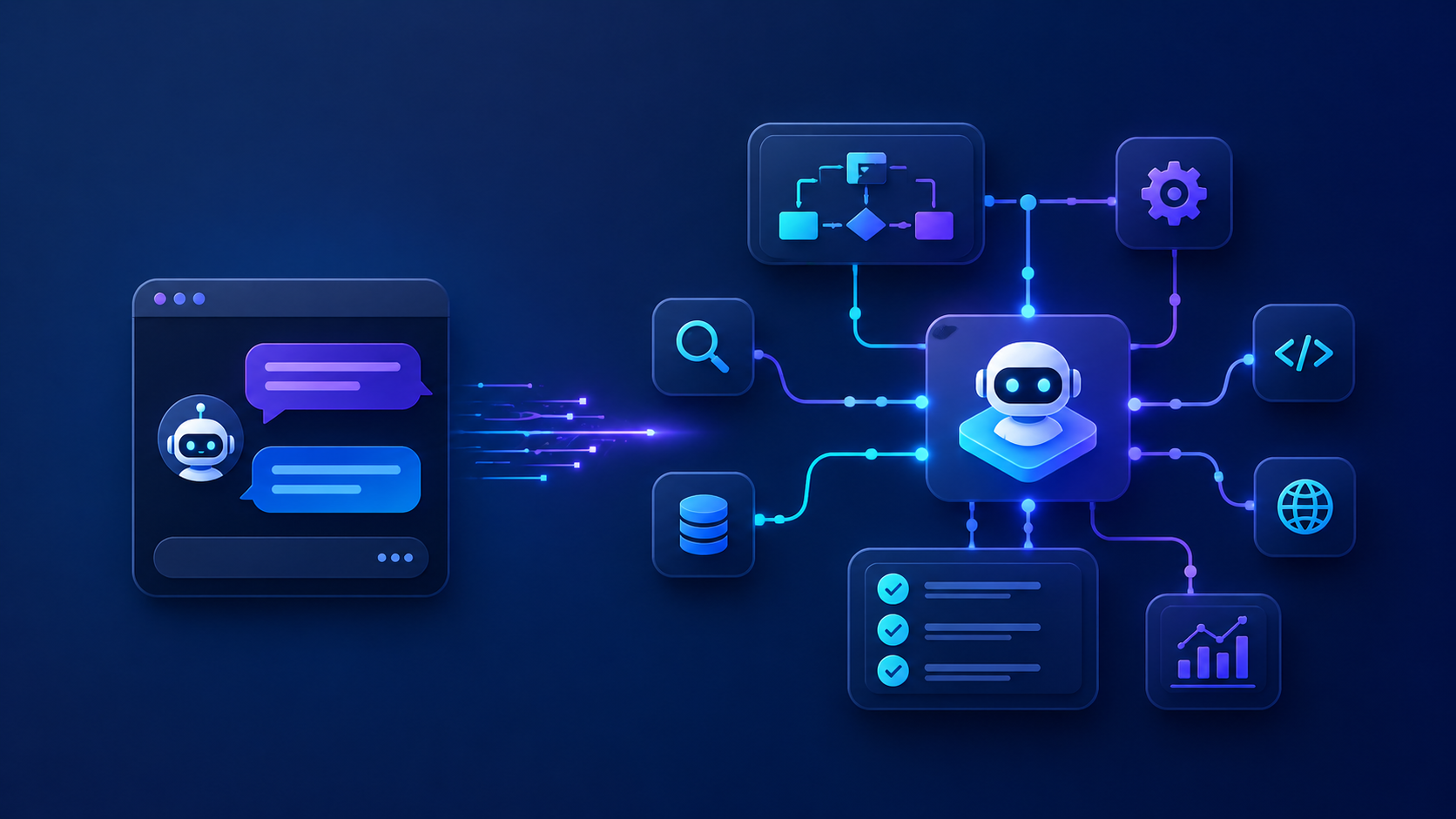
The development of agentic workflows signifies a change from passive chatbots to self-governing systems capable of independent reasoning, planning, and multi-step task execution. Agentic workflows employ a continuous observe-think-act loop to connect with external tools and data, in contrast to typical chatbots that offer single-turn responses.
1. Core Architecture of Agentic Workflows
Your system must integrate four primary pillars to move beyond basic chatbots, such as:
Reasoning Center — Large Language Model (LLM) works like a human brain, as it interprets objectives and determines the next course of action.
Planning and Orchestration — The system breaks down difficult objectives into smaller, more doable activities.
Tool Use (Action) — Agents have access to tools such as databases, Python scripts, and APIs that enable them to carry out practical tasks like updating a CRM or conducting web searches.
Memory management — While long-term memory remembers previous results and patterns to enhance performance in the future, short-term memory keeps track of the current session.
2. Implementation Steps
Define the Mission — Establish a quantifiable objective, such as reduce onboarding time by 50 percent, and map the entire process to determine which areas still require human judgment.
Select a Framework — To handle non-linear pathways like loops and branching logic, use specialist orchestration tools like LangChain or LangGraph.
Build the Toolset — Put together modular scripts or APIs. For instance, a research agent may require a PDF generator, a data analyst, and a web scraper.
Implement Human-in-the-Loop — Set up protectors that require the agent to wait for human approval when performing high-stakes tasks or when its confidence score is low.
Test and Improve — Prior to granting autonomy, the agent must first observe in a listen-only mode. Use technologies like Prometheus or Datadog to keep an eye on performance.
3. Key Design Patterns
Sequential workflow: an assembly-line method in which each agent output serves as the next agent input. Router or supervisor: a central agent assigns specialized expert agents certain responsibilities. Critique or reflection: a secondary agent serves as quality control before the primary work is finalized.
Agentic workflows vs agentic agents: from chatbots to autonomous reasoning
Last month, a tech lead approached us at Co-Ventech, frustrated that their AI-powered support system was still flagging most tickets for human review. They had a chatbot but no process. That makes it important to learn the difference when discussing agentic workflows vs agentic agents.
An agentic agent is the entity (the who). An agentic workflow is the iterative process (the how) that allows that entity to reason, use tools, and self-correct. For those seeking an agentic workflow meaning, it is a system where the AI does not just provide a one-shot response, but plans a task, executes it with external tools, observes the outcome, and refines its path until the goal is met.
According to research from DeepLearning.AI, this iterative approach can often yield better results from a smaller, cheaper model than a one-shot prompt from the most expensive LLM on the market.
Related: The Automation Myth Busted: Why Human-Centered AI Beats 100% Autonomy — more on keeping humans in the loop while still scaling delivery.
Understanding the type of agentic workflows
All automations are not made equal. At Co-Ventech, we classify systems by the complexity of their reasoning loop. Selecting the appropriate tool for the task requires an understanding of the types of agentic workflows.
Reflection loops: after drafting an output, the agent reviews and rewrites it. Tool use: the agent accesses an API or searches a database when it realizes information is missing. Multi-agent orchestration: several agents (such as a coder and a reviewer) work together to complete a task. We find that the most effective AI agentic workflows imitate human departmental organizations by keeping the doer and the validator separate. Co-Ventech specializes in this architectural integrity so AI functions correctly in addition to quickly.
How to build agentic workflows?
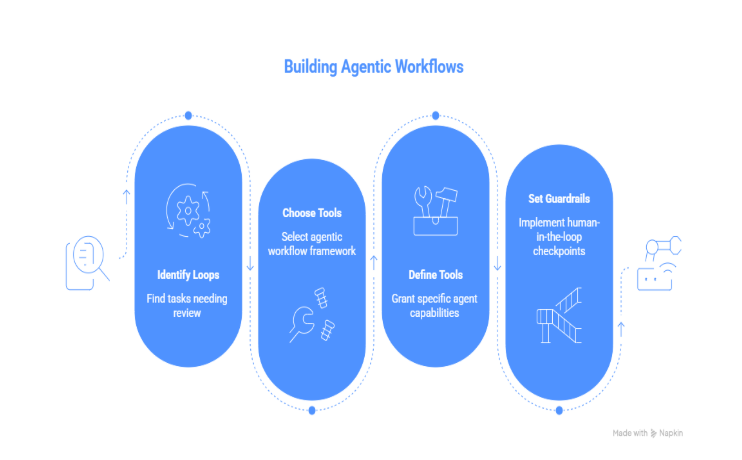
Wondering how to build agentic workflows without overhauling your entire stack? At Co-Ventech, we follow a four-step framework for building agentic workflows for modern software.
Step 1: Look for jobs that require a second set of eyes right now. Step 2: Select tools for your agentic workflow. We suggest frameworks such as Microsoft AutoGen, CrewAI, and LangGraph for complicated, non-linear pathways beyond conventional LLM wrappers. Step 3: Describe the tools: give your agent specialized capabilities such as search, calculator, or database access. Step 4: Establish boundaries with human-in-the-loop checkpoints for important choices.
Industry leaders at LangChain emphasize that the agentic shift is less about the model IQ and more about the workflow design.
Why Co-Ventech is the architect of choice
Because we do not just plug in AI; we engineer the environment where it can succeed. Our expertise in DevOps and human-centered design means we build agentic workflows that are secure, scalable, and controllable. While other firms might give you a chatbot that hallucinates, Co-Ventech provides a sophisticated architecture that reasons. We stand at the forefront of this shift because we prioritize the efficiency and responsiveness that modern agency owners demand.
Your agency's evolution starts here
Whether you need to optimize your QA pipeline or revolutionize your product design, we have the architectural expertise to lead the way. Co-Ventech specializes in turning complex technical hurdles into streamlined, autonomous realities. To stay competitive, you must embrace the autonomy of agentic workflows so your team can stop performing glue work and focus on strategy and client relationships.
Are you ready to move beyond the prompt? Book an AI architecture conversation with Co-Ventech. For a broader view of how we work, visit co-ventech.com.