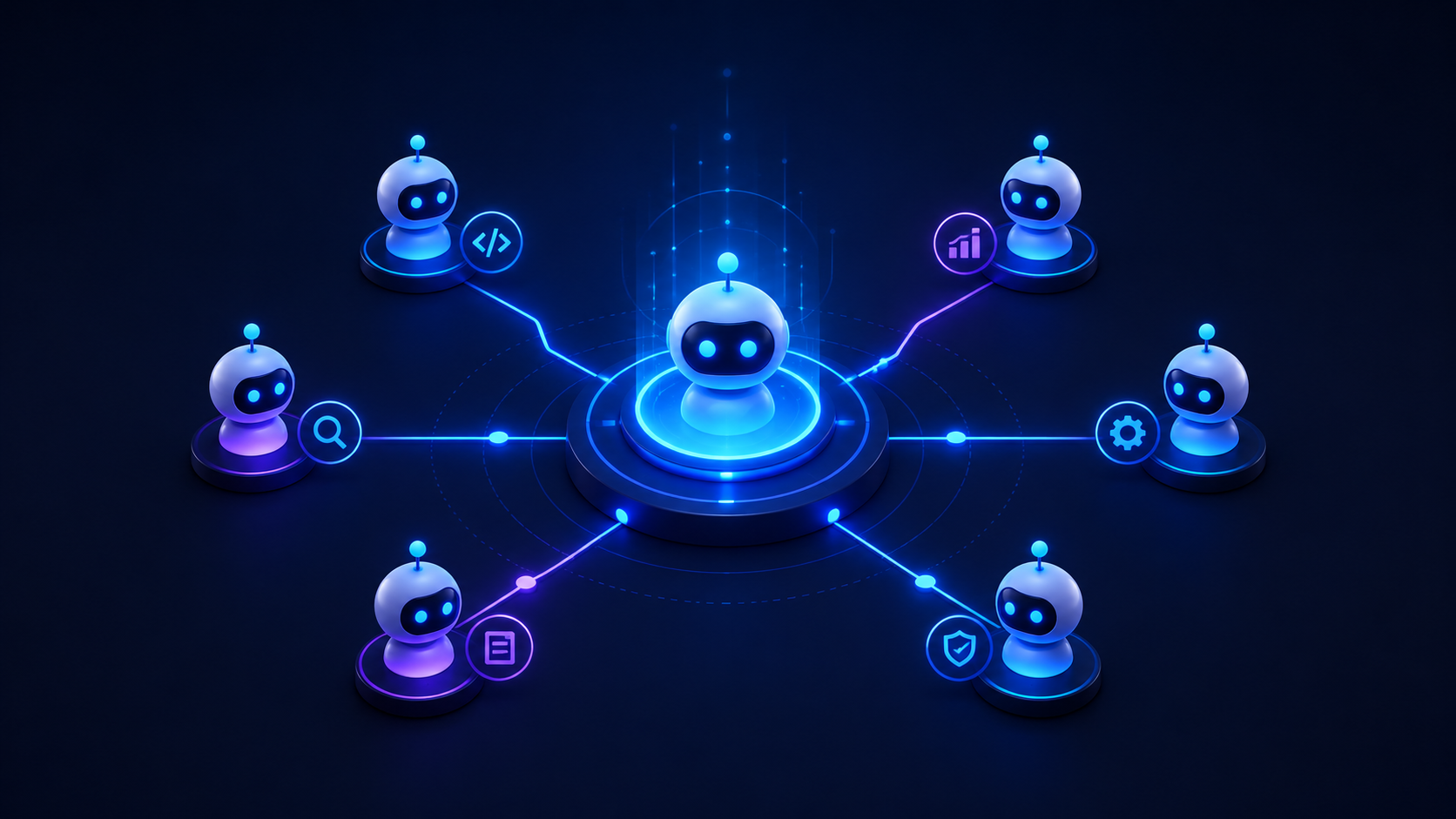
Multi-agent systems just triggered a 1,445% surge in enterprise AI inquiries in a single year, and most product teams are still running on the old playbook.
We have been watching this shift from the inside, and what we're seeing is not a software upgrade, but a structural change in how digital products get built. If your team is still betting on a single, smarter AI model to solve your design and delivery bottlenecks, this TAKE WILL MAKE YOU THINK AGAIN.
Reason? First of all, it's going to bust the biggest myth tech-savvies believing for years that; "Better AI means one more powerful model handling more tasks." Product teams have believed this for years. It is costing them speed, quality, and competitive position, and the data now makes that undeniable.
NO, DON'T CLOSE THE TAB!
Something helpful is just coming your way. Scroll down to learn:
- What multi-agent systems actually are?
- Multi-agent system examples
- what the secret driver behind this shift is?
- How to build multi agent systems?
- Why they are redefining digital product design from discovery through deployment?
- what the secret driver behind this shift is?
- How Co-Ventech has built its engineering practice around these systems to deliver outcomes that single-model AI cannot touch.
By the end, you will know exactly what to look for in a technical partner and what questions to ask before your next product build.
What Multi-Agent Systems Actually Are?
Multi-agent systems (MAS) transform product design by substituting specialized, cooperative teams of agents for single, overworked AI models. This method makes it possible to create concurrent, and scalable workflows for tasks like generative design by increasing capability and resilience.
Important effects include:
- ✓Increased modularity
- ✓Better handling of complicated issues
- ✓Increased accuracy through validation layers
Multi Agent System Examples
- Robotics & Warehousing:
Multiple autonomous robots in warehouses (e.g., Amazon) cooperate to pick, pack, and transport items without colliding.
- Traffic & Transportation Management:
Intelligent systems where agents, such as smart traffic lights, manage congestion by communicating with connected vehicles, and optimizing routes for autonomous taxis.
- AI Software Agents & Research:
Multi agent systems in AI using a "manager" agent to delegate tasks to specialized agents (e.g., a coder, a researcher, and a web browser) to complete complex research tasks faster than a single AI.
- Smart Power Grids:
Agents monitor weather conditions and energy consumption, collaborating to optimize power distribution and detect faults in real-time.
- Healthcare & Diagnostics:
Multi-agent systems support doctors by having specialized agents monitor vitals, review patient history, and suggest treatments concurrently, help diagnosing complex issues like tumor boards.
- Automated Customer Support:
Diverse LLM-based agents, each with specific product knowledge, cooperate to resolve complex user issues, with one agent handling technical queries while another manages billing.
- Financial Trading:
Autonomous agents are used in stock markets to simulate trading strategies and execute trades, allowing for competitive optimization in dynamic environments.
- Defense Systems:
Distributed agents are used to simulate potential threats, such as cyberattacks, to enable proactive, automated response planning.
- Smart Home Coordination:
Connected devices, such as a vacuum cleaner, air purifier, and lighting system, act together, for instance, by reducing noise or improving air quality while a person is present.
Multi-Agent System Orchestration & It's Key Impacts on Product Design
MAS employs specialized agents for certain activities rather than a single AI handling everything (e.g., one agent for design generation, another for structural analysis). By enabling validation layers, the system lowers errors and hallucinations by having one agent verify another's output.
Another helpful advantage of using multi-agentic systems is, large-scale, complicated design challenges can be divided into smaller, more manageable subtasks that can be completed concurrently.
Moreover, MAS bridges the gap between digital design and physical production in generative design by enabling fabrication-aware agents to instantly assess design viability.
The Secret Driver: Specialization at Coordination Speed
Every major productivity shift in software has had a hidden engine. In the cloud era, it was elasticity. In the microservices era, it was modularity. In the multi-agent era, the engine is specialization combined with coordination speed.
A single generalist AI model working alone is fast but shallow. It spreads its capacity across every task, which means no task gets the model's full depth. A multi-agent system orchestration layer changes that entirely. An orchestrator agent routes each task to the specialist best equipped to handle it. The researcher agent does not try to validate outputs. The validator agent does not try to generate designs. Each does one thing, does it well, and hands off cleanly.
The coordination protocols making this scalable: Anthropic's Model Context Protocol (MCP) and Google's Agent-to-Agent Protocol (A2A). MCP standardizes how agents connect to external tools, databases, and APIs, turning what was previously custom integration work into plug-and-play connectivity.
A2A defines how agents from different vendors and platforms communicate. Together, they are building the interoperability layer that makes multi-agent systems composable and reusable across products.
The Result: Proven agents built for one product can be reused across multiple client workflows. Build once, deploy many times. The compounding efficiency is real and measurable.
Related: "Finally Revealed: The Agentic DevOps Pipeline That Cuts QA Time by 60%"
How Multi-Agent Systems Are Redefining Digital Product Design? Stage by Stage
Here is what changes at each stage of the product lifecycle when multi-agent system design replace single-model workflows.
Stage 1: Discovery and Requirements
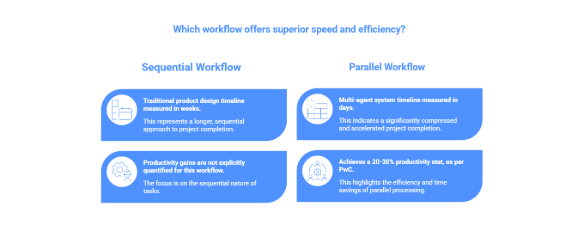
Traditional discovery runs sequentially: research lead compiles data, product manager interprets it, designer translates it into wireframes. Every handoff introduces delay and interpretation gaps.
A multi-agent workflow runs this in parallel. For instance: One agent parses user research data. A second cross-references it against existing product specs. A third automatically surfaces conflicting requirements. The consolidated brief that used to take three to five days is ready in hours, and it is cleaner because the agents caught inconsistencies before they reached the design team.
Stage 2: Prototyping and Design Iteration
This is where the single-model assumption fails most visibly. A single model asked to generate design variants, validate them against WCAG 2.1 accessibility standards, and score them against UX criteria does all three adequately and none of them well.
In a multi-agent system design workflow, each of those tasks belongs to a specialist agent. Design generation, accessibility validation, and UX scoring happen in parallel. Designers review and refine outputs rather than generating them from scratch. Human judgment moves to where it creates the most value: evaluation and decision-making.
Stage 3: Development and QA
Quality assurance is where multi-agent systems show the clearest ROI. Parallel agents run regression suites, monitor for visual regressions, check API contract compliance, and flag conflicts for human review, all simultaneously.
The numbers: A major financial institution that deployed a 12-agent fraud detection system saw detection accuracy climb from 87% to 96% and false positives drop by 65%, saving $18.7 million annually.
The same parallel specialization principle applies directly to software QA. PwC reports 20% to 30% productivity improvements in workflows using specialized generative AI models.
H3: How to Build Multi-Agent Systems: What Product Teams Need to Know?
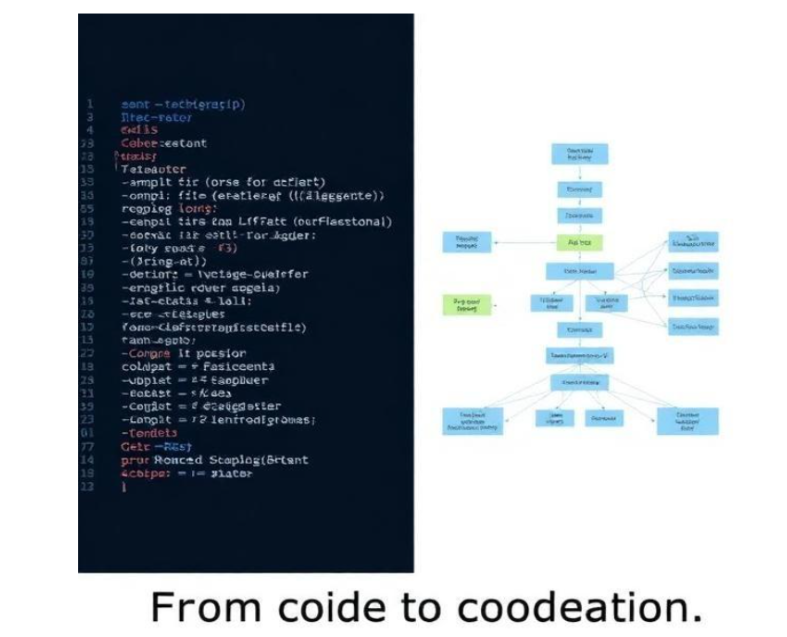
One of the most common questions we hear from tech leads: "How do we actually build this?" Here is the honest answer, because there is a spectrum. For teams asking how to build multi-agent systems from scratch, the foundational stack typically looks like this:
Framework layer - AutoGen, Semantic Kernel, LangGraph, or LlamaIndex for agent orchestration
Communication layer - MCP or A2A protocols for inter-agent and tool connectivity
Memory and state management - Persistent context stores so agents maintain awareness across a workflow
Observability layer - Real-time monitoring, audit logs, and escalation paths for human review
Governance layer - Compliance frameworks aligned with EU AI Act requirements and industry standards
For teams exploring multi-agent system Python implementations, frameworks like: AutoGen and LangGraph are the current leading options.
Multi-agent systems using Python ReAct (Reason + Act) architecture is a widely used pattern where each agent reasons through a problem before taking action, creating a structured loop of thought, tool use, and output that makes agent behavior more predictable and auditable.
The infrastructure requirement is significant: cloud systems capable of 10,000+ API calls per hour, dedicated AI/ML engineering staff, and integration pipelines with existing business tools. Initial implementation costs range from $500K to $5M depending on scope, with 6 to 18 months to full deployment for teams building in-house.
This is why most agencies and product teams choose to partner rather than build alone. Co-Ventech brings existing frameworks, QA engineering rigor, and DevOps infrastructure to these projects, reducing both time-to-value and implementation risk.
How Co-Ventech Leads the Multi-Agent Systems Shift?
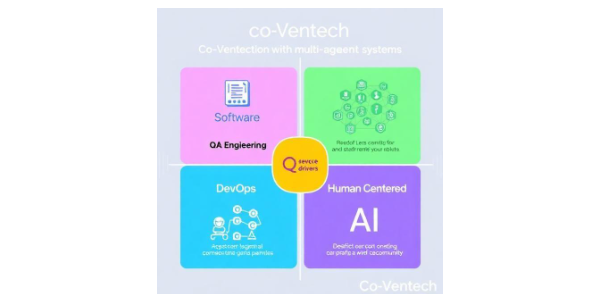
Most firms read trend reports and add "AI-powered" to their service descriptions. Co-Ventech builds the engineering systems the trend reports are analyzing. We have integrated multi-agent architecture across our four core service lines, treating agent coordination as a deliverable competency, not a marketing claim.
Here's how work speaks in volume:
In QA engineering: Co-Ventech runs parallel test agents covering regression, visual regression monitoring, and API contract compliance simultaneously. Clients see fewer production bugs and shorter QA cycles without sacrificing coverage depth.
In custom software development: Orchestrator-agent workflows compress requirements-to-wireframe timelines and catch conflicting requirements before they reach the design team, eliminating the mid-project pivots that derail budgets and schedules.
In DevOps: Monitoring agents watch different system health metrics while flagging anomalies before they escalate into incidents. That proactive posture is what enterprise clients are moving toward.
In human-centered AI innovation: Co-Ventech builds the transparency layers, governance frameworks, and human-in-the-loop validation systems that make agentic products trustworthy at scale. A capable system users do not trust gets replaced. A capable system users trust becomes infrastructure.
Co-Ventech's approach is not to apply multi-agent principles after the architecture is set. It is to design for them from the first scoping session.
The Competitive Window Is Narrow. Here Is What to Do Next.
The myth that a smarter single model solves your product design challenges had a long run. The data has retired it. Multi-agent systems are not the next version of AI. They are a different architecture entirely, built for the complexity that single-model AI cannot handle.
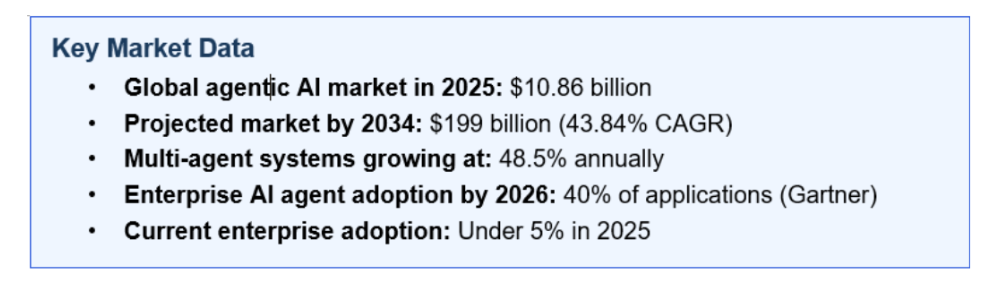
The numbers are clear. Only 34% of organizations successfully implement agentic AI despite significant investment. 40% of projects fail due to inadequate infrastructure. The failure point is almost never the technology. It is the implementation strategy and the engineering partner behind it.
If your product roadmap includes any of the following, it is time to have a direct conversation about multi-agent architecture:
➤ Compressed product design and delivery timelines
➤ QA cycles that scale without proportional headcount growth
➤ Custom software that needs to integrate with AI-driven workflows
➤ DevOps infrastructure that catches issues before they reach production
➤ Products that need to meet emerging AI governance and compliance requirements
Co-Ventech is the engineering partner built for this work. With active multi-agent system integration across its custom software, QA engineering, DevOps, and human-centered AI practice, we bring the frameworks, the engineering depth, and the delivery track record to move product teams from concept to production-ready agentic systems without the implementation failure risk.
So, what are you waiting for? Connect with Co-Ventech at coventech.com