Growth is the ultimate goal for any SaaS founder, but it often comes with a hidden tax: operational chaos. We have seen brilliant teams invest for months to build a groundbreaking feature, only to have their momentum crushed by a sudden surge in traffic that their infrastructure could not handle.
The traditional solution has always been hiring more DevOps engineers and QA testers to keep the ship upright. But this linear approach to scaling is exactly what holds your margins hostage. Still doubting the wonders of autonomous agents for SaaS applications?
The following CRITICAL BENEFITS OF AUTONOMOUS AGENTS FOR SAAS will make you think again, as you will learn how autonomous agents for SaaS systems provide the technical leverage you need to decouple growth from headcount. You will further explore the shift from reactive scripts to intelligent, goal-oriented systems and see how this technology delivers concrete ROI for your product roadmap.
By the end, you will understand how to build a self-sustaining infrastructure that lets your engineers get back to what they do best: innovating.
What Are Autonomous Agents? Understanding the Shift
Autonomous agents revolutionize SaaS infrastructure by enabling consistent autonomous operations, reducing human intervention, and boosting productivity by 15–30%. AI-driven systems accelerate GTM by 55%, enhance reliability, and enable personalized customer experiences, acting as a competitive differentiator that scales infrastructure without linearly increasing headcount.
Unlike basic automation, autonomous agents for SaaS applications can observe their environment, reflect on their performance, and adapt to unforeseen errors without human intervention. This capability is exactly what autonomous AI agents are focused on: the power of independent, context-aware decision-making.
Which Capability is Focused On Autonomous AI Agents?
Action (or acting) is the primary capability of autonomous AI agents, allowing them to freely perceive, make decisions, and carry out actions to accomplish objectives. These agents, in contrast to classical AI, use memory and reasoning to function independently. They frequently use tools or software to accomplish multi-step tasks without continual human assistance.
Key aspects of this autonomous action include:
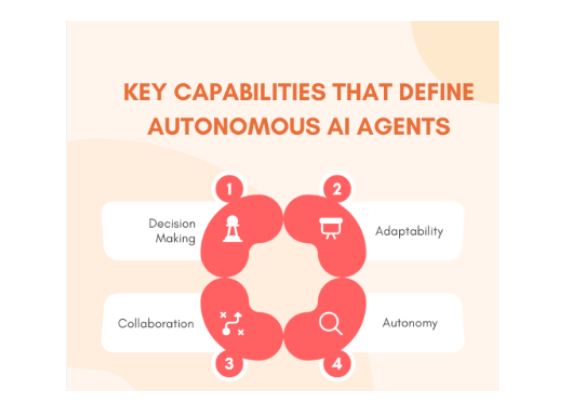
Action-Oriented (Action) — The capacity to interact with environments by utilizing APIs or clicking buttons to do tasks.
Independent Decision-Making — Choosing the optimal course of action by applying reasoning and preparation.
Adaptability & Reasoning — Analyzing feedback iteratively to modify plans and draw lessons from past experiences.
Also read: Latest Update: How Multi-Agent Systems Are Redefining Digital Product Design — more on multi-agent design when that article is live.
Benefits Of Autonomous Agents For SaaS Applications & Systems
Here are 5 critical benefits of autonomous agents for scaling SaaS:
#1. 24/7 Operational Resilience & Self-Healing:
Autonomous agents for SaaS applications provide round-the-clock, independent monitoring and proactive issue resolution, ensuring uptime without manual intervention during system failures. This self-healing capability minimizes downtime and allows teams to focus on strategic initiatives rather than firefighting operational issues.
#2. Seamless, Non-Linear Scalability:
Unlike human teams, autonomous agents for SaaS systems scale instantly in response to growing data, user demands, or system complexity. This ability to adapt without incurring direct costs supports rapid growth while maintaining operational efficiency, creating a flexible environment well-suited for evolving business landscapes.
#3. Accelerated Go-To-Market (GTM) Speed:
By automating testing, quality assurance, and deployment pipelines, autonomous agents for SaaS use cases empower companies to launch features up to 55% faster. This acceleration not only enhances competitive advantage but also enables faster feedback loops, allowing teams to refine and adapt products quickly based on real user insights.
#4. Proactive Customer Experience & Churn Reduction:
Agents analyze user behavior in real time to trigger tailored retention workflows, delivering highly personalized interactions that eventually boost customer satisfaction. By anticipating customer needs, these agents can enhance loyalty and reduce churn, ultimately driving more revenue through sustained relationships.
#5. Intelligent, End-to-End Workflow Orchestration:
Salesforce Agentforce positions modern agents as a cohesive system rather than just task automators: agentic workflows can manage complex, multi-turn procedures such as updating a CRM, coordinating database changes, and managing communications. This orchestration improves overall productivity by streamlining operations and improving cross-team communication.
Busting the "Supervision" Myth
Many agency owners believe they need to hire an AI manager to watch their agents. This is the myth we are here to bust. While there are free autonomous AI agents available for hobbyist experimentation, professional-grade systems like those Co-Ventech implements are built with built-in guardrails.
You do not supervise the agent's every move; you simply review the agent's logs and intervene only when a high-level strategic decision is required.
Partner with Co-Ventech for the Future of Engineering
Scaling a SaaS is hard enough without your infrastructure working against you. The shift to autonomous agents for SaaS is not just a trend; it is the new standard for modern engineering talent. It is about building a system that is as responsive and efficient as the people who created it.
Co-Ventech positions itself as a leader in this human-centered AI revolution. Whether you are struggling with rising cloud costs, slow deployment cycles, or infrastructure reliability issues, we have the DevOps and QA expertise to help you implement a reliable, agile framework.
So, are you ready to see the ROI of agentic automation firsthand? Contact us today for a comprehensive technical audit, and let us build a platform that scales as fast as your vision. Explore more at co-ventech.com.